Pages

Thursday, 2 February 2017

Synthetic Wing Materials

When I first got into saltwater fly-tying I had no idea about materials and which ones to use. I became a bit obsessed with different types especially when it came to tying the good old Clouser. Although Buck tail is available here in NZ I found it lasted only a few fish, limited range of colours or easy to work with. So I started collecting different synthetic materials to see what would be the best substitute and well along the way I learnt a whole lot about all the different materials that can be used not just for Clousers but all sorts of flies.  
Here is a list of some of these materials and the advantages/disadvantages of each. 
 
Mirror Image- This has been one of my favorite materials as it is easy to work with and shape,  easily creates bulk, some translucency, has more movement than SFF and is durable. Great for smaller flies and comes in generous amount. I also use this material as the collar on my smaller interceptors. Although it does not have as much movement as natural materials it does move to some degree more than other synthetics. There is no flash incorporated but it does if you get deadly dazzle or you can blend some yourself. It does tangle a bit and needs reshaping after a few fish but last longer than natural materials. 
 
Deadly dazzle-same as mirror image but with UV flash added. I prefer mirror image as it comes in larger hank for the same price and I add angel hair instead. 
 
SFF- One of the more popular saltwater flytying materials this material is great for creating larger flies and adding bulk/profile but not so good on smaller sizes less than sz1. It comes in a great range of colours and is very translucent.  It also incorporates a bit of flash pre blended. 
 
Craft fur – another favorite material this one gives loads of action in the water but requires a wrap up under tail to prevent any tail wrapping. It can also be laid down with layers of angel hair or other shredded mylar. Although it has plenty of action I do find it is a bit fragile compared to stiffer materials. 
 
DNA – a very flashy material and very straight this material is good for slim flies like clousers and surf candies or even wing toppings and I have seen this used on large profile flies but you would be using most of a packet on a couple of flies. This material is now only used sparingly.  
 
EP – This material is a crinkly synthetic which is softer than SFF and less crinkly so it does have more movement and thicker profile but the key to this material is not to use too much. It is very easy to overdo it and have a solid coloured fly and lose the translucent effect. Bunkers and crabs are often tied with his fly but using a softer material for tail and using this material for wing would be better suited but it is great for crab patterns. E.g. deceivers/ interceptors or crabs. It also is prone to getting tangled and needs a comb to straighten. 
 
Angel hair/Ice wing/Wing n flash –most of these materials are the same but angel hair is the straightest. Used as flash in between layers or the lateral line. You can create whole flies with this material but ice wing may be best for this as it creates more bulk being the more crinkly 
 
Mega mushy – A very stiff mylar this is suited to large flies sz1 and bigger and is great for making large profile flies without using too much material. Comes in a large pack. Enough to create loads of flies. It doesn’t have as much movement as materials such as angel hair.  
 
Polar flash – one of my favorite materials. It has plenty of flash and movement and is very durable. I have fished Clousers made with just this material and been very successful. 
There are many more materials than I could ever count but I hope this gives just a good run down on some of the main winging materials.  
PS after all this work and money on different materials I am now finding that the good old buck tail still can't be beat and I am starting to get a higher hit rate on them, although this can be just more confidence in them. 

Stay tuned for further articles on flytying materials 

Gulf Harbour Marine Reserve

Well it's not really a marine reserve but where else in Auckland area can you go see large quantities of rat kings and snapper that you can feed and watch their behaviour. I took the kids out to the Gulf Harbour Marina as I had heard about these fish and I was not disappointed. The fish literally fight over the morsels you throw at them and will even take it out of your hands. The kids loved it! 
Most of it is a no fishing hence why there are so many fish there but there are areas outside the Marina you can fish. 
I have been to goat island many a time before but this is something completely different. (especially since you can feed them) 

If only all our fisheries were like the Marina the fun we would have. 

There is a fishing shop along the way that you can purchase some bait. Just walk along the walkway and there are two main groups. One made mostly of snapper and the other mostly rat kings with bigger snapper mixed in. 


Saturday, 7 January 2017

Nuclear Fishing

I was on a recent fishing evening (I say evening as I have a limited window to fish usually being a couple of hours) and I was casting my way up a channel using the usual chartreuse clouser. I changed flies to a new fly I have had recent success with in murky water but had not tried in cleaner. Instantly I was into a fish but lost it as I couldn't keep pressure. A few casts later and I was into a nice panny that I put back. After a few more cast I was into another. It went on like this for 30-40 minutes until it was too dark to see and I had caught a total of 8 fish. The fly I put on was an adaption of the nuclear chicken soft bait with pink and chartreuse. I have had success with a pink over white fly and chartreuse over white fly but put the two together doubles the fun. 


For tying please see the previous article pea soup.

Saturday, 2 July 2016

Flies Simplified


What fly do I use? With a multitude of flies on the market and online choosing the right fly can be a confusing issue. What fly and to use when and how. So here I thought I would give a quick breakdown of the main flies and their uses. Most flies come under a few categories and everything else is a variations of this. The categories I would use are:
  • Clouser
  • Deceiver
  • Half n Half
  • Interceptor/snapper snuffer
  • Synthetic flies
  • Carbs and shrimps

Clouser


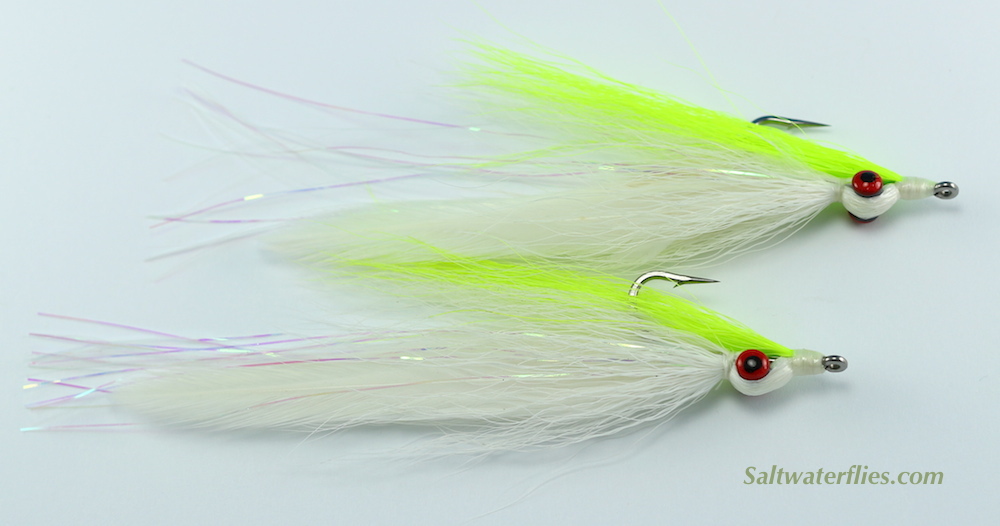
Probably the most popular fly in the world and the reason for that is it just works. If I had to fish with just one fly this would be it. You can catch just about every type of fish with this fly and in fact 90% of my fish caught are on this fly. It can be tied with natural or synthetic materials. The main differences for fish type is the type of retrieve. Snapper and trevally like their flies slow and Kahawai and kingfish like theirs medium to fast.  There are however always exceptions to this.
I have caught Kahawai, Snapper and even Kingfish on this fly and my favourite sizes are 2 and 1 although i am now making bigger flies for deeper water in sizes 1/0-2/0. Anything larger than this is to hard with bucktail so a synthetic would be best.
Sizes: 4 and bigger
Colours: olive/white, chart/white, pink/white, all white

Deceiver

Another classic fly that can be tied with a range of materials.  This fly has no weight so is best for species that hunt near the surface such as Kahawai and kingfish.
Fish them in anything from a size 2 and up but primarily I would use 1/0 or 2/0 for kingfish.
My first ever flats fish was on a deceiver but unfortunately I got smoked. The great thing about this fly is the feather tail which moves well in the current. To aid this further the feathers are usually splayed rather than placed back to back. You can use this fly in shallow water or add some weight under the body or as per the next fly the half n half

Half n Half
This fly is half clouser half deceiver. Used mostly when you need clousers in bigger sizes and need to get some depth.
Same size/colours as deceiver but some good options are
Orange/black (fanterella) -good on snapper
Pink/white -good on snapper or trevally
Chart/White - good on just about anything 

Interceptor/Snapper snuffer

The interceptor was created by Craig Worthington for fishing for snapper. The fly has lots of weight to get down deep and the tail sits up and waggles in the current.  You can experiment with how large a dumbbell you want to reach your desired sink rate and depth.
Craig has  great success with yellow interceptors but my favourites are chartreuse, pink or pearl.
Size: 1 and bigger although my favourite sizes are 1/0-2/0
The snapper snuffer is the same fly but with saddle hackles added in a splayed arrangement. This gives extra movement with the feathers as they snap together when pulled through the water. Mainly used on the larger flies 2/0 and larger. May also goes by the name FBI (F@#ing big interceptor)

Synthetic flies


These flies are ones that are made entirely from synthetics such as EP flies and SFF flies. Mainly they are used for bigger flies for kingfish. Anything 1/0 and larger

Crabs and Shrimps

There are numerous different ones out there.  Charlies and Gotcha are a good imitation of shrimps and you can even use a small clouser.
Crabs you can go for either an EP style crab or something with more movement like marabou


Most of the time the presentation is more important than the fly so that means making sure you have enough weight if your trying to get to the bottom and the retrieve. I will be posting an article on retrieves later.

Thursday, 19 May 2016

Pea Soup


Recently I went back to one of my favourite spots. Unfortunately the tide was lower than I would have liked and as being near low was pretty murky. I was not feeling confident about the fishing but threw in some pilchard and had a go.
I remember reading an article by Craig Worthington called fishing in the muck where he used bright flies in murky water so I tied on a nuclear chicken Clouser. This proved to be quite successful as I managed to walk away with 6 small snapper. No keepers but certainly saved the day.  Now I need to try this colour combo on clear water and see what results I get.
I will also be experimenting with other fly types in this colour combo e.g. Interceptors, Deceivers and Half n half's. 

Nuclear chicken Clouser
Hook: Size 2-1
Dumbbell: Small on size 2 or med size 1
Wing: Pink over chart buck tail and Krystal flash

I tend to use the size 1 for the deeper water but you could go up to a 1/0 and maybe put on a large dumbbell if you need the depth.


Saturday, 14 May 2016

Hip Shooter


After my last go at a stripping tray I had a few issues I needed to iron out. One was line hanging over the sides which caught up under the tray or on rocks as I was walking. This made it hard to walk around the rocks casting. The other issue was it was very light which in some ways was good but in windy conditions was hard to get it to stay straight.
Thus after seeing an old thread on the blow link and wanting to be able to walk while ready to cast I started looking at the hip shooter. There is the original manufactured one on-line but this is no longer being made.
Basically I got a cheap 15 litre bucket from plastic box and set to work. You can put spikes in the bottom or as I did just use a piece of foam and slip cable ties in them. This can then be taken out and used on a boat if needed. All up it cost $10
I also added a hole and a groove for sitting my rod on while changing flies. The result I can have all my line in the bucket ready to let fly as soon as I spot a fish with no resistance.
The key is to have the bucket sitting low on the hip so that you can strip long strips into it rather than feeling cramped like the ones that sit high on your waist.
On my first outing I was almost into my backing with my cast. So wading and casting is now a breeze. Kingies here we come!


http://www.fishing.net.nz/forum/hip-shooter-mark-3_topic101150.html

Saturday, 5 March 2016

Kingfish on the flats

I have just arrived home from a weekend on a "Salt Water Fly" weekend chasing kingis in Tauranga. I did manage to catch about 15 small kahawai but the kingis were rather hard work for me. There was lots of waving a stick around for not much return and I have come back with some thoughts/info to contemplate for my next attempt at the elusive kingi. 

Get a boat or floatation devise 
After struggling all weekend while all the guys on the boats were out catching fish I came to realise that we were severely hamstrung by not having some sort of flotation.  The two main advantages are being able to cover more water and view. While there we had one day of near flat conditions. Perfect for spotting yet being in the water I could only see 2 metres in front of me as well as the fact that even if I saw something further than this I was limited in being able to get close enough. So with this in mind I think it's essential to have a full flats boat, kayak or paddle board etc.  
You can of course catch fish from the shore but choosing your location becomes critical. Looking for places with points or rock ledges where fish cruise past so you don’t need to move far.

Get High (as in the non-smoking variety) 
So following on from this the main consideration on seeing fish besides bow waves which are not always present is to get height to view the fish.  This can be either from a rocky ledge or from your boat/floatation devise or even a ladder. This will give you the maximum distance to view your prey. 

Glassy conditions/flat water 
This is also related to view but to see the fish you need to be able to see into the water. Normally this means little to no wind. Or being in a sheltered area away from the wind. The other idea is to get the sun behind you which helps cutting out the glare.

Early bird gets the worm 
This then leads onto time of day. As the first part of the morning  is often little to no wind. The first light part of the morning is often best up until the wind picks up. Often it's time to quit by 10am.  Although wind often drops off at the end of the day I often find there is still a small breeze rippling the surface so glassy conditions are rare.

Hip shooter line control 
The hip shooter or strip basket/tray can be invaluable in being able to cast quickly to your intended target.  Having line out conveniently ready so you can get that quick cast out without tangles is essential. Also when you're in the water you don’t want to having to strip line off before casting as this takes time or have to wade with line dangling behind you that you have to get off the water to cast.  Here is a link to a home made one which i will be trying. I have a stripping tray which i have posted previously but the line tends to hang over the sides and still get tangled on the rocks.
http://www.fishing.net.nz/forum/hip-shooter-mark-3_topic101150.html


Patience -casting to sighted fish 
Patience, patience and patience. I am much too impatient but if you're not poised ready to pounce like a tiger waiting for its prey the moment will be there in front of you and you won't be ready. You have all of 20 seconds to get that cast right in front of the fish. If you miss the window you could be waiting a while for the next one. 

Ray riders  
Many kingis follow the ray riders and this follows a bit from the last point. If you see a ray just get a cast in because by the time you see the kingis following it's too late. 

Fly weight 
Not sure on this last theory but is seems those kingis that follow rays will ignore offerings near the surface even though they can see them as they are hunting along the bottom. So having some weight on your flies so they kick up off the bottom is advantageous. This theory I think I need to play around with a bit. 

Other quick notes 
We also got some information on fishing for Trevally which like a fly with a soft tail as they often mouth it first and to cast into the channels and work a slow figure 8 retrieve up the edges into the shallow water. Often hits are just when the fly is coming up the lip.